

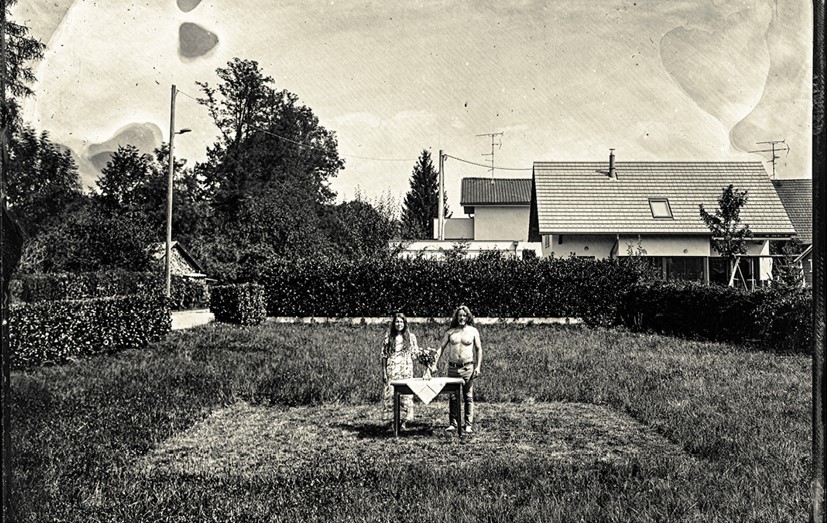
Feels Like Home
Gallery Božena, Photo House Pelikan
13 October 2026 – 8 February 2027
The exhibition Feels Like Home brings together, for the first time in a shared exhibition space, the artistic practices of Borut Peterlin Wolf Gang and Valerie Peterlin Wolf Gang. Having developed their own artistic languages independently over many years, the two artists now consciously intertwine their work with their private lives. The exhibition is therefore not only a meeting of two artistic practices, but also of two life paths and two ways of understanding images, time, memory and belonging.
At its heart is a simple yet elusive question: what is home?
Is home a place we return to? Is it a house we build? Is it family, a memory, or another person’s presence? Or is it, above all, a feeling we carry with us even when everything around us is changing?
For Borut Peterlin Wolf Gang, Feels Like Home is the result of a decade-long photographic and personal journey. The series began with the end of a twenty-one-year relationship, when the coordinates of home, family and belonging that had once seemed self-evident changed along with the relationship itself. What followed was a decade of moving, searching and creating temporary homes. During this process, photography became more than a document of time. It became a ritual.
Whenever he found himself in a new and unfamiliar space, he began to make it his own through photography. He would place a bouquet of flowers and a camera in the space, arrange the light, and, through a slow and physical photographic process, transform his surroundings into something of his own. Taking a photo became an act of making a space feel like home. Where there was no history, an image emerged. Where there was no memory, a trace was created. Where there was no sense of belonging, photography created a first connection.
The title Feels Like Home therefore does not necessarily refer to home itself, but to the feeling of its presence and absence – to those moments when we try to create a sense of familiarity in a space that does not yet feel like ours.
Borut works with historical photographic techniques from the nineteenth century, above all wet-plate collodion on glass, ambrotype, albumen, silver gelatine and carbon printing. His photos are made on glass plates in various formats, and producing each image requires physical presence, time, chemistry, light, precision, knowledge and patience. The deliberate pace of these processes is at the heart of his work.
In a world where images are created almost effortlessly and disappear just as quickly, Borut brings photography back into the realm of the material. An image is not merely a representation of an event, but an object and a physical trace of its existence. Light is literally inscribed into the emulsion, and the photo becomes a material trace of a moment.
The ritual of preparing the bouquet, camera and light, and of coating, exposing and developing the glass plate, allowed the artist to confront life in a different way. The creative process became a way of translating distress into action, uncertainty into observation, and the feeling of being at a dead end into creation.
Such small rituals bring one back to the present moment. To the body. To the space. To the light.
The photographs are therefore not merely records of the places where the artist lived, but traces of an inner process. Like tiny cracks in the darkness through which light enters, they suggest that periods of loss do not necessarily mark the end of a story. After ten years, the series comes to an end where a new story begins: with marriage, the creation of a family and the establishment of a new home.
While Borut Peterlin Wolf Gang explores the material and psychological traces of the search for home through photography, Valerie Peterlin Wolf Gang approaches the same question in a new video installation through moving images, words, sound and intimate experience. She returns to video art, which played an important role in her earlier artistic practice. Although in recent years she has explored new media, virtual environments and augmented reality, in Feels Like Home she consciously returns to one of her original creative forms – video poetry.
Where does the feeling of home begin for someone who has spent much of their adult life moving between different countries, cities, temporary homes and cultural environments? For more than a decade, Valerie lived, studied, worked and created abroad. The search for new environments was connected with building an artistic and professional path, while at the same time creating a distance from the traditional idea of home. Home became increasingly unstable and fluid, something no longer necessarily tied to geography.
Her video installation emerges from a deeply personal moment: her return, her relationship with Borut, their life together, marriage, the creation of a family and the building of a new home. Yet the personal story is only a starting point for a broader question: what do we need to feel at home somewhere? For some, home is family; for others, a house, a city or a country. For some, home may simply be the presence of a particular person.
Video poetry does not offer a definitive definition of home, but understands it as an inner state – a space of closeness, security, memory and belonging. Home is no longer necessarily architecture. It can become a relationship.
This is where the artistic practices of the two artists meet.
Borut attempts to make a space feel like home through photography. Valerie asks whether we need a physical space at all to find home. His photos speak of the spaces he has passed through, while her video installation speaks of the feeling she searched for during her journeys. His work emerges through the slowness, materiality and physical presence of the photographic process; hers through movement, sound, words and poetic association. Despite their differences in medium, technology and artistic language, their practices in Feels Like Home converge on the same question:
How does a person recreate a sense of belonging after periods of change?
The exhibition is therefore also a story about time. About a decade in which the two artists, each following their own path, searched for something they perhaps did not know how to name at first. Borut through photos of empty and temporary spaces, Valerie through journeys, moves and movement between different environments.
Their stories meet at a certain point.
And so does the meaning of the word home.
Home is no longer simply the place we come from.
It becomes something we create.
Home is a process that changes and grows with time, ebbs and flows, and is, in a sense, alive. And within it, there is space. Space with memory. With ritual. With art. With another person.
Feels Like Home is therefore not simply an exhibition about their life together. It is an exhibition about the universal human need to belong. About the moments when we lose the space we understood as our own, and about the moments when we have to piece it together again.
Sometimes from a photo.
Sometimes from light.
Sometimes from an image, a sound or a memory.
Sometimes from another person, beside whom we suddenly realise that we have come home.